The Children's Environmental Health and Disease Prevention Research Center is a five-year, $8 million dollar grant jointly funded by the National Institute for Environmental Health Sciences and the U.S. Environmental Protection Agency. Dartmouth leads the multidisciplinary effort in collaboration with Stanford University, Harvard Medical School and the University of Miami.
"With the expansion of the center, we will have the opportunity to deepen our understanding of environmental exposures to common contaminants such as arsenic during fetal development and childhood; and the impact these exposures have on childhood immunity, growth, and neurological development," says Margaret Karagas, director of the center. Carol Folt, now Chancellor of the University of North Carolina at Chapel Hill, is associate director of the center and a project co-investigator.
Dartmouth's interest in the effects of arsenic toxicity on the young has its roots in studies initiated in 2009. These extensive ongoing studies began with a group of pregnant New Hampshire women who obtained their household water from a private well in areas where some of the water supplies have been found to be arsenic-laden. The offspring of the women will also be studied to determine how these children might be affected over time by relatively low-level arsenic exposure. The Center, in its pilot phase, discovered that certain foods contributed to arsenic exposures in children, including rice and rice products, and recently reported findings of increased infection risk in children (Environmental Research, 2013), and changes in DNA in umbilical cord blood (Environmental Health Perspectives, 2013) and placenta tissue, relating to low birth weight (Environmental Health, 2013), associated with in utero arsenic exposure.

Children’s Environmental Health & Disease Prevention Research Center
"The center will conduct research that can help us develop and implement strategies to prevent diseases associated with arsenic and other exposures in children," says Karagas, a professor in the Department of Community and Family Medicine at Geisel School of Medicine at Dartmouth.
"Center members constitute a highly committed team of diverse scientists who bring an array of skills and expertise to our research programs," says Karagas. Their specialties include environmental, nutritional and molecular epidemiology, public health, pediatrics, ecology, nutrition, bioinformatics, biomedical informatics and trace element analysis.
Karagas says that the center’s mission is to identify and address key emerging issues related to health impacts of early life environmental exposures. "There is growing research connecting exposure early in life to a number of prevalent and life threatening diseases for children," she says. "Moreover, early life exposures and their effects also appear to extend beyond childhood."
Evidence suggests that environmental exposure may affect the development of the immune system, and in turn infant risk of emerging diseases such as allergies and asthma, she says. Diseases known or suspected to be caused or aggravated by arsenic in drinking water include various cancers and cardiovascular disease.
"Additionally, risk of obesity, which has greatly increased in prevalence in both children and adults, is influenced by factors occurring early in life," says Karagas. "Therefore, if environmental contaminants increase early life growth, they will heighten risk for obesity which is a major risk factor for cardiovascular disease and cancer."
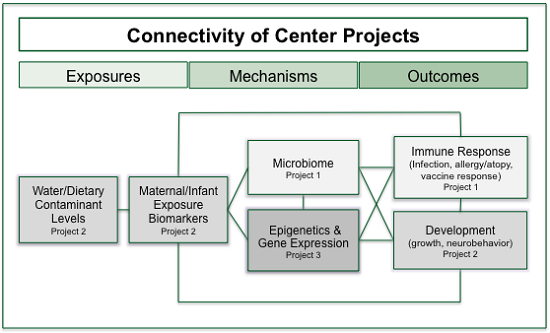
Interwoven projects and Cores constitute the essence of the center's research pursuits:
Project 1: Childhood Immune Function and Exposure, is led by Karagas, and is investigating the effects of exposures on both mothers and infants, and their susceptibility to allergies and infection. The project builds on the study begun in 2009 of pregnant New Hampshire women, whose well water had elevated arsenic levels. The health of their children will be evaluated by the study team.
Project 2: Water and Dietary Arsenic Exposure Related to Early Growth and Neurodevelopment, is led by Kathryn Cottingham, professor of biological sciences, Susan Korrick, an assistant professor in the Harvard School of Public Health and Diane Gilbert-Diamond , an assistant professor of community and family medicine at Geisel. This project quantifies arsenic exposure through water and food during infancy and early childhood and determine its impact on growth and neurological development. This augments exposure data collected from the children identified in the first project, from conception to age 5.
Project 3: Placental Biomarkers of Exposure and Outcome, is led by Carmen Marsit , an associate professor of pharmacology and toxicology, and of community and family medicine at Geisel, and David Robbins, a professor in the School of Medicine at the University of Miami. This project examines epigenetic and gene expression changes in the placenta in relation to arsenic exposure and health effects.
John Moeschler serves at the Child Health Specialist for the Center, and Carolyn Murray directs the Community Outreach and Translation Core to ensure research findings are communicated with key stakeholders including the medical community and the public.
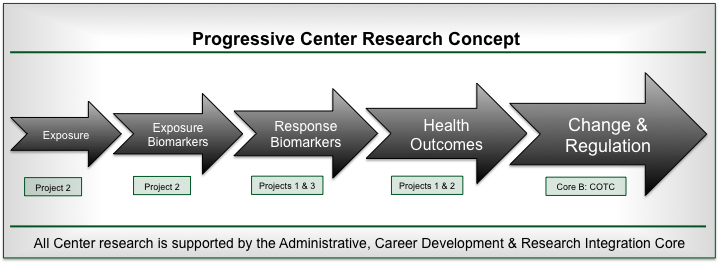
Our study obtains exposure data, innovative biomarkers beginning in early life, and measurable health outcomes. This approach makes it possible to inform interventions and changes in medical practice which have great potential to improve human health over the entire life span. The progressive research concept of our center transitions from the initial exposure, to how those exposures are reflected in biologic tissue samples, and in turn markers of biologic response to environmental agents, and to the health outcomes which ultimately lead to change and regulation.
Our study obtains exposure data, innovative biomarkers beginning in early life, and measurable health outcomes. This approach makes it possible to inform interventions and changes in medical practice which have great potential to improve human health over the entire life span. The progressive research concept of our center transitions from the initial exposure, to how those exposures are reflected in biologic tissue samples, and in turn markers of biologic response to environmental agents, and to the health outcomes which ultimately lead to change and regulation.
Research Projects
-
Emerging data point to significant effects of arsenic during the vulnerable window of fetal development and early childhood. Altered immunity is among the key pathways identified in experimental studies and in highly exposed populations. But such studies do not exist in the US at levels relevant to our population. Infectious diseases are responsible for the majority of early childhood deaths worldwide. In the US, infections are the most common causes of illnesses in children, and allergy and atopy have become a widespread source of childhood morbidity. Our study builds on an established cohort study to determine whether common exposure levels of arsenic and other contaminants influence children’s immune response including risk of infection, allergy/atopy, vaccine response and intestinal microbial acquisition. The cohort comprises 1,000 mother-infant dyads who are residents of New Hampshire and obtain household water from private wells, a potential source of arsenic exposure in the region. We now have compelling preliminary data both from animal studies and early epidemiologic data from our cohort that indicate aberrant immune function and clinical phenotypes related to arsenic exposure that support our hypotheses. Further, recent discoveries are beginning to uncover the fundamental role that the establishment of microbiome early in life plays on immune development and competency as well as in metal biotransformation. Our team has acquired the expertise to evaluate environmental influences on the developing microbiome and are poised to translate recent experimental findings on As and intestinal microbial composition during the critical neonatal period.
To our knowledge this is among the first prospective molecular epidemiologic studies of As and child health in the US, and among the only children’s cohorts with detailed childhood infection information along with other immune-related variables. Thus, using a state-of-the-art, multidisciplinary approach, we have a unique opportunity to relate both clinical and biologic markers of immune function with multiple routes of As exposure (i.e., via water and food) using biomarker measurements (maternal As exposure during pregnancy via urine and toenails, and infants exposure during their first five years of life via nails, urine) in collaboration with Project 2, along with mechanistic changes (e.g., placental epigenetics, gene expression profiles) in collaboration with Project 3.
-
Emerging evidence suggests that exposure to high concentrations of arsenic in drinking water can adversely impact prenatal growth and childhood cognitive development. Much less is known about the child health effects of arsenic at the lower doses that are commonly consumed through drinking water in the U.S. Moreover, recent research suggests that diet may be the most significant source of arsenic exposure for the general U.S. population– though relatively little is known about dietary sources of arsenic. Understanding arsenic exposure through both diet and water is important to assessing exposure risk, especially in young children who are rapidly developing and may be the most vulnerable to contaminants.
The goal of this study is to quantify children’s exposure to arsenic via both drinking water and food, and to evaluate whether this exposure affects physical growth and neurological development. Our study focuses on the New Hampshire Birth Cohort (NHBC), which recruits from a population where about 15% of households have private wells with arsenic concentrations above the current maximum contaminant level of 10 µg/L. We will characterize pathways of early life arsenic exposure by assessing how biomarkers of exposure (e.g., urine and toenail arsenic levels during pregnancy, infancy, and early childhood) are related to dietary assessments during infancy and childhood. We will then evaluate how these arsenic exposure biomarkers are related to growth and adiposity during the first five years of life, as well as behavioral skills, cognitive ability and motor proficiency between the ages of 3 and 5 years.
Thus, this innovative work will combine detailed longitudinal assessment of early life arsenic exposure and subsequent physical and neurological development to better understand the exposure sources and children’s health impacts of this common contaminant in a U.S. population.
-
There is mounting evidence that the environment experienced by a pregnant woman can have a profound influence on the health of her child both at birth and throughout that child’s life. Our project is focused on trying to understand, at the molecular level, how environmental signals and exposures during this short period of development can impart these lifelong impacts. We are specifically examining the importance of the placenta in delivering these environmental signals to the developing child and how the environment can alter the way the placenta functions.
The placenta is the first complex organ to form and serves as a critical interface between the developing infant and his or her mother. This organ facilitates the passage of nutrients, water, gases, and waste between mother and infant, but also plays other important roles during development. The placenta produces specific hormones, growth factors, and neuropeptides which direct fetal development, and also through production of various enzymes, receptors, and transporters, controls the types of chemicals and exposures that can pass from mother to infant.
We believe that environmental factors, like arsenic exposure from food or water, effect the way the placenta performs these important functions, and that alterations to these functions can lead to changes in the health and development of the infant. Our study specifically looks at alterations to the expression of key development genes and arsenic associated pathways, to demonstrate the functional effects of arsenic exposure on the placenta.
We are also examining the epigenetic regulation of genes in the placenta by utilizing genome-wide studies of DNA methylation. These studies will pinpoint critical genes and pathways altered by arsenic and other environmental exposures and can ultimately be linked to growth and neurobehavioral outcomes in the child. Studies such as ours, will allow us to better understand the molecular mechanisms at work mediating the maternal environment’s role in child health. Such findings, we believe, could eventually be translated into novel targets for therapeutic intervention or applied as molecular diagnostics to identify children at risk at birth so that appropriate and useful interventional strategies can be initiated.
-
The importance of combining state-of-the-art research with the translation of this work to the community has been an integral component of the Children's Environmental Health and Disease Prevention Research Centers program since its inception by the EPA and NIEHS 15 years ago. Here at the Dartmouth Center we aim to engage a wide range of stakeholders to protect the environmental health and wellbeing of children in a sustainable manner. Key members of our community are the mothers who are participants in our Birth Cohort study, the health care community, and parents. Given our researchers focus on mechanisms and effects of early life exposure to metals, in particular arsenic in food and water, the COTC seeks to explore ways to incorporate these findings into clinical care and public health practice.
Our Partnerships and Projects
The Dartmouth Northern New England Primary Care Cooperative, also known as the "Dartmouth CO-OP".
We are collaborating with this practice based research network of rural primary care practices in New Hampshire, Vermont and Maine. In our current research study, we are working with selected practices in regions where there are a high percentage of families on private water systems to identify best practices for integrating well water testing into routine pediatric preventive care. This involves both education of the parents as well as the health care team on the basics of drinking water safety and testing, with particular emphasis on the regional importance of natural arsenic contamination. Our team's use of GIS mapping of arsenic contamination in relationship to the location of these regional primary care practices has been used to raise awareness of this issue among health care providers and for recruitment of practices to the well water testing study. Results of this study will be disseminated to other regional practitioners.
Our Center was selected as a project site for the "Dali Lab"- a group of talented computer science students and their faculty mentors within the Department of Computer Science at Dartmouth College. Students in the Dali project worked with Dr. Carolyn Murray to bring to life in a digital format the "story" of how arsenic enters our food supply. These undergraduates translated the Center's research findings about sources of arsenic in the diet and converted them to a visually pleasing and interactive format to engage and empower the public, particularly parents.
New Hampshire Birth Cohort Participants
Participants in our birth cohort study that now numbers over 1,200 are a high priority community for our Center. We have been conducting focus groups within the NHBCS. Through these focus groups and future surveys we are seeking input on how best to communicate well water testing results, how best to design educational materials, and to better understand where mothers obtain the environmental health information they use to make decisions about their own health and that of their children. We will then use this information to inform the development of educational resources, both written and web based, to support the informational needs of our stakeholders and provide a platform for our scientists to share their findings.
Vermont Law School Center for Agriculture and Food Systems
This newly created Center in one of this country's premier law schools for Environmental Law underscores the burgeoning interest in food, food policy and the relationship between our food systems and human health. We meet regularly with Center leaders to identify how our scientific findings can help inform their efforts in addressing regulatory initiatives aimed at improving the health and safety of our food supplies. We are both working with the Dartmouth DALI lab (see below) on exciting projects to share our research findings with stakeholders in innovative ways.


Basic
Add your pricing strategy. Be sure to include important details like value, length of service, and why it’s unique.

Intermediate
Add your pricing strategy. Be sure to include important details like value, length of service, and why it’s unique.

Advanced
Add your pricing strategy. Be sure to include important details like value, length of service, and why it’s unique.